
.svg)
How does ultrasound work in the treatment of varicose veins?

Ultrasound can close varicose veins without surgery. Here is how HIFU technology works, from the physics of ultrasound to its precise action on the vein wall.
- Varicose veins form when leg vein valves fail and blood flows backwards.
- Echotherapy treats them with focused ultrasound (HIFU), without any incision.
- The heat closes the vein, which the body then reabsorbs naturally.
- No scalpel, no injection, no scar and no operating theatre.
- You can return to your normal activities right after the session.
Venous insufficiency and one of its most visible symptoms, varicose veins, affect roughly 1 in 3 people. Beyond traditional treatments that are often invasive and uncomfortable, echotherapy is one of the most innovative methods in the field. Delivered by a high-performance robotic device, the SONOVEIN, it is based on high-intensity focused ultrasound (HIFU).
What is ultrasound?
Ultrasound is an elastic, mechanical sound wave (a vibration) that is inaudible to the human ear. It propagates through solid, liquid or gaseous media, and also through biological tissues that are naturally rich in water.
How is it produced?
Ultrasound relies on the phenomenon of piezoelectricity, discovered by the brothers Pierre and Jacques Curie in 1880. Certain materials such as quartz produce an electric field when pressed. This electrical energy is then converted into mechanical energy using a transducer, and it is this mechanical energy that is used in many fields.
What are its applications?
Ultrasound has long been used in industry and agriculture. Totally harmless to health, it is also used in medicine for:
- diagnostics: ultrasound scans, echo-Doppler, and more;
- therapeutics: treatment of certain tumours, fibroids, nodules and kidney stones and, since 2019, varicose veins thanks to the SONOVEIN.
How does ultrasound therapy work?
Because ultrasound can pass through the skin, the SONOVEIN device uses a beam of high-energy ultrasound waves (HIFU) which, when focused on specific points, generate thermal energy (around 85°C) in the skin and subcutaneous tissue.
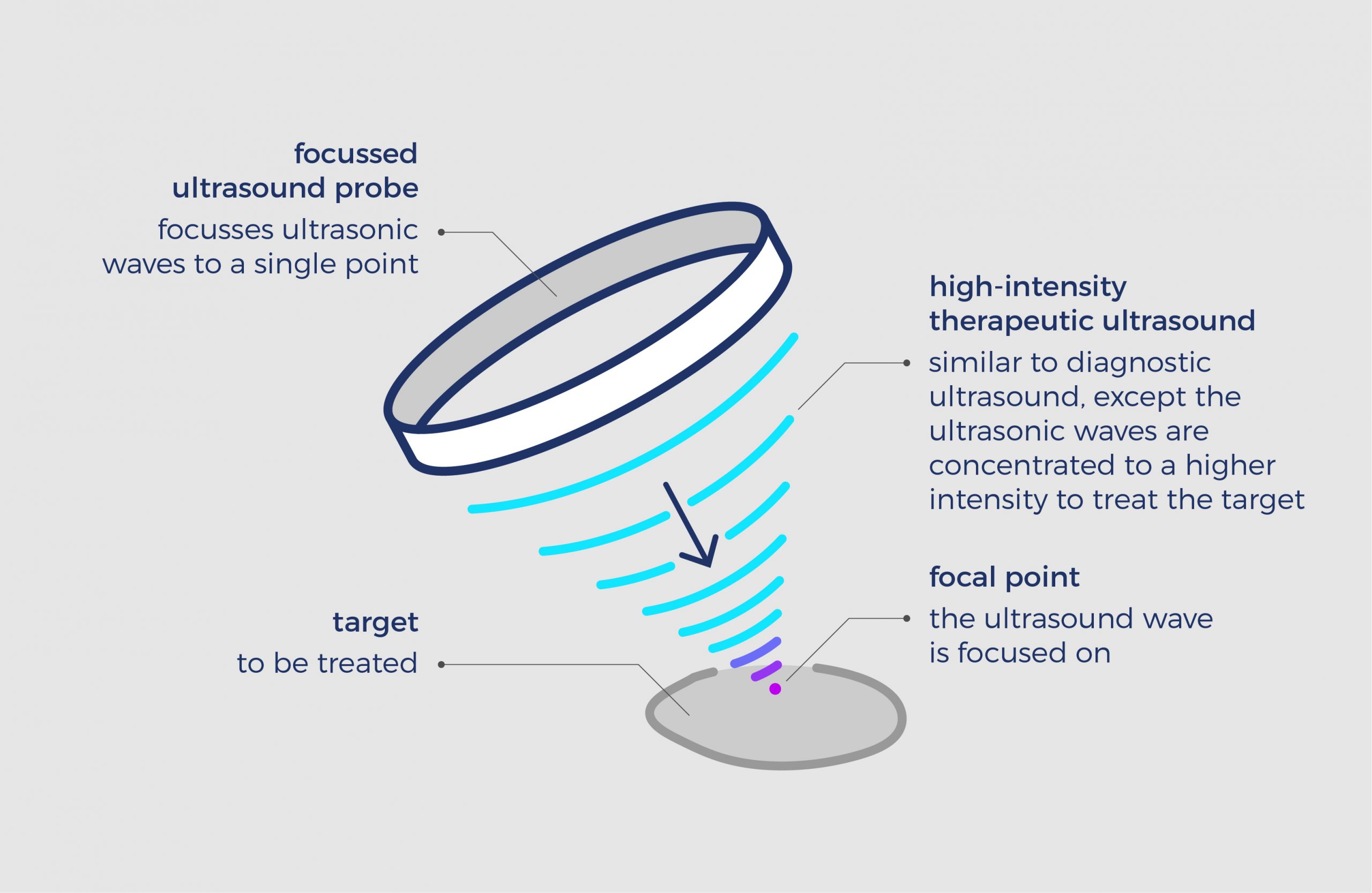
The energy is delivered by an extracorporeal treatment probe (transducer) equipped with an imaging system for live monitoring of the treatment, and a cooling system that, together with dedicated software, protects the patient skin from thermal damage.
The ultrasound used in this procedure reaches powers thousands of times greater than diagnostic ultrasound, yet it targets with millimetre precision, so the surrounding tissue is not damaged.
What is the effect on varicose veins?
Varicose veins are characterised by an abnormal and permanent dilation of the superficial veins in the leg, which take on a tortuous, purplish appearance.
They are caused by a malfunction of the valves in the legs or a deformation of the vein wall. When the valve system is defective, blood tends to flow back down towards the foot instead of being pushed up towards the body. The venous return no longer happens correctly, which is what produces visible veins.
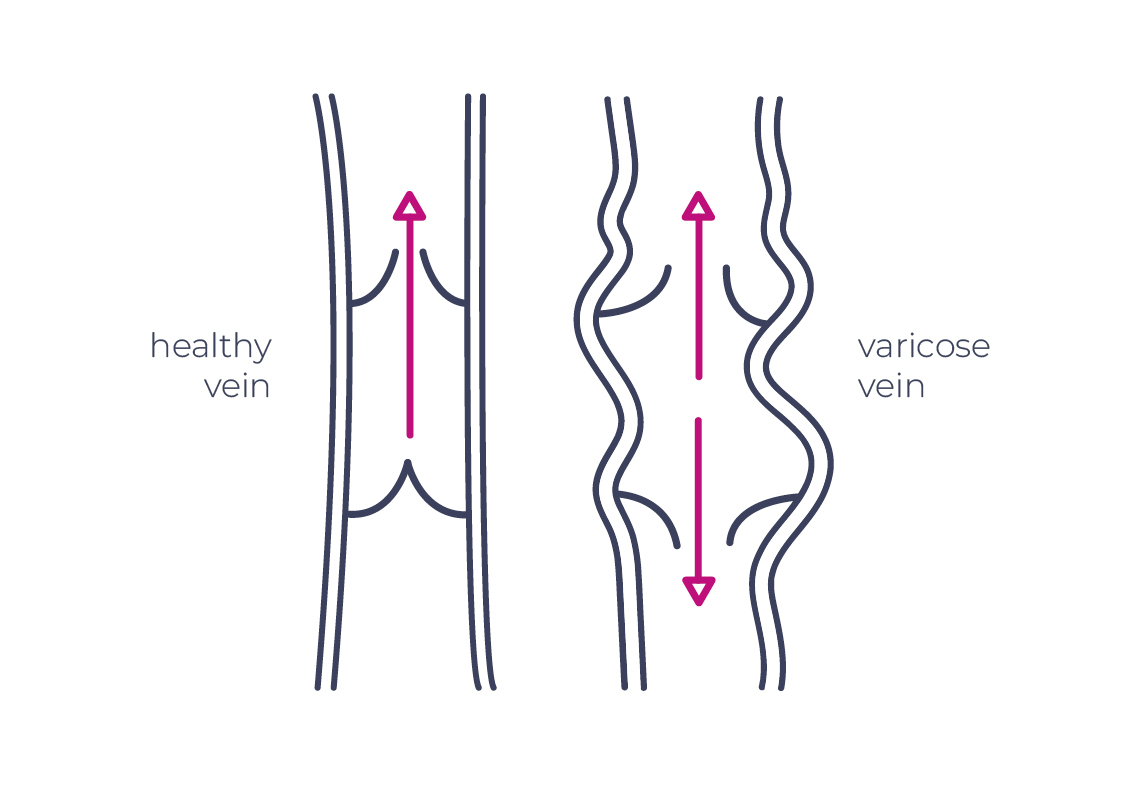
When the faulty valves let blood flow back down the leg, the vein dilates and becomes visible. This is the vein the practitioner aims to close.
Once the faulty vein has been identified, echotherapy offers a way to treat it without ever touching the skin surface.
How does ultrasound work on varicose veins?
The therapy relies on the collagen-rich composition of the vein walls. Step by step, here is what happens during treatment:
Focused heat
HIFU concentrates ultrasound on a point the size of a grain of rice, raising it to around 85°C.
Collagen reaction
The heat stimulates the collagen in the vein wall and turns it into a kind of glue.
The vein closes
The wall retracts, the vein progressively shrinks, then blocks and closes.
Natural resorption
Once necrotic, the vein is gradually reabsorbed by the body and disappears.
The advantages of this method, with no scalpel, no injected product and no operating theatre, are numerous: no scars, no risk of infection, the ability to treat all types of veins including tortuous ones, and an immediate return to daily activities.
Wondering whether the treatment is available near you? A growing network of centres is already equipped with the SONOVEIN.
Frequently asked questions :
Is ultrasound treatment for varicose veins painful?
The procedure is non-invasive and performed without any incision. The heat is delivered through the skin in tiny focal points, and a cooling system protects the skin, so the treatment is designed to be comfortable.
How hot does the HIFU ultrasound get during treatment?
The focused ultrasound generates thermal energy of around 85°C at the targeted point, within the skin and subcutaneous tissue, while the surrounding tissue is spared thanks to millimetre precision.
Does the treated varicose vein disappear?
Yes. The heat shrinks and closes the vein, which becomes necrotic and is then progressively reabsorbed by the body until it disappears.
Can echotherapy treat all types of varicose veins?
The method can treat all types of veins, including tortuous ones, because the ultrasound beam is focused precisely and requires no incision or catheter.
Can I return to my normal activities after the session?
Yes. As there is no scalpel, no injection and no operating theatre, patients can generally resume their activities immediately after the treatment.