
.svg)
5 reasons to have your legs checked for varicose veins this January

Heavy or itchy legs, or veins showing under the skin? Here are five good reasons to have your legs checked for varicose veins, and why now is the time.
- Venous insufficiency affects about 20% of adults and worsens if ignored.
- Untreated, varicose veins can lead to ulcers, phlebitis or embolism.
- Family history, static jobs and excess weight all raise the risk.
- Winter suits treatment, and echotherapy leaves no scar year-round.
- Early diagnosis prevents most complications, so book a check-up.
Have your legs been itchy, swollen or heavy these past few months? Do you see dilated, curled veins under your skin? Have you been putting off seeing a doctor for years? Make it your first good New Year resolution. Here are five reasons to have your veins checked this month.
1. Better safe than sorry
Varicose veins come from venous insufficiency, a disease that affects about 20% of adults worldwide. It usually starts with harmless spider veins, but left untreated this chronic condition can lead to serious problems:
- Swollen legs (edema)
- Eczema
- Ulcers
- Phlebitis
- Thrombosis
- Pulmonary embolism
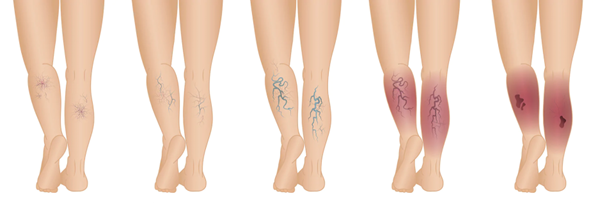
Chronic venous disease progresses in stages, from spider veins to varicose veins, swelling, skin changes and, eventually, ulcers. Catching it early keeps it from advancing.
Getting diagnosed early can ease the pain and discomfort and prevent other symptoms from developing.
2. If varicose veins run in your family
Because varicose veins are so common, it is worth asking your relatives about them: studies show they are strongly hereditary.
| Family history | Risk of developing varicose veins |
|---|---|
| Both parents affected | ~90% |
| One parent affected (women) | ~62% |
| One parent affected (men) | ~25% |
A family history is worth mentioning to your doctor. Whatever the cause, varicose veins can be treated without surgery: focused ultrasound (echotherapy) closes the vein with no incision.
3. If you sit or stand for long hours
Sitting all day, or standing for more than four hours, adds pressure on your legs and hinders circulation. Blood returns to the heart through your veins, and when the one-way valves weaken, blood pools and varicose veins appear. Teachers, hairdressers, nurses, flight attendants, drivers and office workers alike can be affected, depending on genetics and hours spent static. And since we tend to walk less in winter, do not wait to see a doctor.
4. If you are overweight
Excess weight raises pressure in the abdomen, which in turn presses on the leg veins and makes it harder for them to return blood to the heart, a setting in which varicose veins can appear. No guilt about the holiday feasts, but now is a good moment to ask whether your weight is affecting your legs.
5. Winter is a good season to get treated
Winter has long been seen as the best time for treatment, because some methods leave marks that should stay out of the sun. With echotherapy and the SONOVEIN platform, though, treatment can be done all year round: the non-invasive method uses focused ultrasound to treat the vein from outside the body, with no scar, and you can return to your activities straight away.
Which doctor should I see?
If you suspect varicose veins, consult a phlebologist (vein doctor), an angiologist (vascular doctor) or a vascular surgeon. Ready to start the year on the right leg? Wondering whether echotherapy is available near you? A growing network of centres is already equipped with the SONOVEIN.
Frequently asked questions :
When should I have my legs checked for varicose veins?
See a doctor if your legs feel heavy, itchy or swollen, or if dilated veins appear, especially with a family history. Early diagnosis prevents most complications.
Are varicose veins hereditary?
Yes. If both parents have them, a child's risk is about 90%; with one affected parent it is about 62% for women and 25% for men.
Does my job affect my risk of varicose veins?
Sitting all day or standing more than four hours a day adds pressure on the leg veins and can trigger or worsen varicose veins, especially with a genetic predisposition.
Is winter the best time to treat varicose veins?
Traditionally yes, because some methods leave marks that should avoid the sun. With echotherapy, which leaves no scar, treatment can be done all year round.
Which doctor treats varicose veins?
Consult a phlebologist, an angiologist or a vascular surgeon; echotherapy centres can be found on the centre map.