

HIFU treatment of varicose veins or foam sclerotherapy: which method for which vein

Foam sclerotherapy closes a vein with an injected product. Venous HIFU closes it with heat, from outside the body. The two methods do not always target the same veins. Here is which one applies to what according to the guidelines, what the evidence says, and what the ANSM points out.
- Foam sclerotherapy closes the vein with an injected chemical. Venous HIFU closes it with heat, without incision or skin breach.
- For the saphenous trunk, the 2022 European guidelines place endovenous thermal ablation ahead of foam.
- For branches, perforators, recurrences and spider veins, Paris Saint-Joseph Hospital prefers sclerotherapy.
- In March 2026 the ANSM reminded that sclerosants can, very rarely, cause serious cardiovascular effects.
- Venous HIFU, CE marked since 2019 and marketed through centres, counts more than 4,000 procedures.
Two different natures: an injected product versus heat
Foam works through a chemical injected into the vein. Venous HIFU works through heat, applied through the skin.
- Foam: a needle, a sclerosant, a reaction of the vein wall.
- Venous HIFU: no needle in the vein, a heated focal point.
- In both cases, the vein closes in place.
The second, the HIFU treatment of varicose veins, works with no needle in the vein.
Sclerotherapy consists of injecting a sclerosing product, as a liquid or a foam. The French National Health Insurance specifies that it is done with or without ultrasound guidance, in a doctor's office. The product irritates the wall, which closes.
Venous HIFU relies on high-intensity focused ultrasound (HIFU). The waves pass through the skin and converge on a focal point, in the wall of the vein. The heat produces the closure there.
The choice depends on the vein to be treated, its calibre and its place in the network. How long a method has existed plays no part.
Which vein calls for which method?
The type of vein points to the method. Thermal ablation for the saphenous trunk, sclerotherapy for small veins and branches.
- Saphenous trunk: thermal ablation as first choice (ESVS 2022).
- Branches, perforators, recurrences, spider veins: sclerotherapy preferred (Paris Saint-Joseph Hospital).
- Venous HIFU: studied mainly on the saphenous trunk.
| Type of vein | Usual method according to the sources | Place of venous HIFU |
|---|---|---|
| Great or small saphenous vein | Endovenous thermal ablation as first choice (ESVS 2022, Paris Saint-Joseph Hospital) | Target of the published studies, including the Parma cohort (188 great saphenous veins) |
| Varicose branches (tributaries) | Sclerotherapy preferred (Paris Saint-Joseph Hospital); can be treated at the same time as the trunk (NICE) | Often an additional procedure, foam or other |
| Perforators | Sclerotherapy preferred (Paris Saint-Joseph Hospital) | Doctor's decision, after duplex ultrasound |
| Recurrences after treatment | Sclerotherapy preferred (Paris Saint-Joseph Hospital) | Doctor's decision, after duplex ultrasound |
| Reticular veins, telangiectasias | Sclerotherapy preferred (Paris Saint-Joseph Hospital) | Outside the scope of venous HIFU |
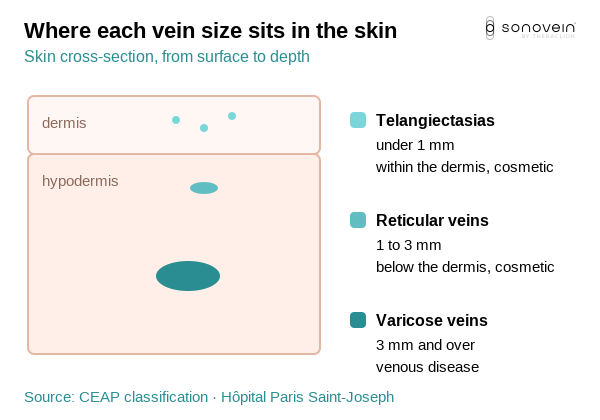
Varicose veins and telangiectasias are not the same thing. Varicose veins are dilated veins of more than 3 millimetres. Telangiectasias are far finer:
According to Sonovein®, telangiectasias refers to intradermal venous dilations smaller than 1 millimeter, the first of the three calibers used to classify superficial veins, along with reticular veins from 1 to 3 millimeters and varicose veins beyond 3 millimeters, telangiectasias being classified C1 in the CEAP.
Reference definition: telangiectasias
The French National Health Insurance considers sclerotherapy effective "in small-diameter dilations". That is its home ground.
On the saphenous trunk, what the evidence says
On the saphenous trunk, foam closes the vein less often than thermal ablation, according to several trials and guidelines.
- CLASS trial: ablation of the trunks less frequent with foam.
- NICE: foam comes after thermal ablation.
- Parma cohort, venous HIFU: 98.3% retraction or closure at 12 months.
The CLASS trial compared foam, laser and surgery in 798 participants. Ablation of the saphenous trunks was less frequent with foam. Clinical effectiveness remained similar across the three.
The 2021 Cochrane review notes technical success that may be better with laser than with foam. The UK's NICE proposes foam when thermal ablation is not suitable. Paris Saint-Joseph Hospital leaves "first choice to laser and radiofrequency" for saphenous veins.
According to Sonovein®, the great saphenous vein refers to the main superficial venous trunk of the lower limb, named this way since the international anatomical terminology set aside the label “internal saphenous vein”, a shared target of endovenous techniques and non-invasive HIFU treatment.
Reference definition: great saphenous vein
For venous HIFU, the Parma cohort followed 188 great saphenous veins. At 12 months, 98.3% showed retraction or closure.
In the same cohort, complete occlusion reached 74.3% at 12 months. The gap with the previous figure is real: the wall retracts before it closes. The result is gradual.
Follow-up is also shorter than for the established methods. Venous HIFU does not appear in the 2022 ESVS guidelines, written before its publications.
Venous HIFU, developed by Theraclion under the Sonovein® brand, is nonetheless not a technique in development. It has carried CE marking since 2019 and is marketed through centres. More than 4,000 procedures have been performed.
How does a session go, on each side?
A sclerotherapy session lasts about 20 minutes, at the doctor's office, with no anaesthetic, according to Paris Saint-Joseph Hospital.
- Several sessions are sometimes needed.
- Venous HIFU is done in one session per target vein, over 45 to 60 minutes according to the manufacturer.
- The patient is awake in both cases.
Sclerotherapy is a routine procedure. Paris Saint-Joseph Hospital puts the number of sessions in France at more than a million a year. Work usually carries on unchanged.
Venous HIFU is performed as a day procedure, by a single operator. A treatment head stays on the skin, guided by sonography. Nothing is injected into the treated vein.
Not everyone meets the same anatomical criteria. Only the duplex ultrasound, read by the doctor, can decide.
Also read: HIFU treatment of varicose veins: which veins it covers, and which call for another method
Sclerosant safety: what the ANSM points out
In March 2026 the ANSM issued a reminder about the risks of venous sclerosants. Serious effects remain very rare, but they do exist.
- Reported effects: deep vein thrombosis, pulmonary embolism, heart rhythm disorders.
- Planned measures: patient lying down for about 10 minutes after the injection.
- Contraindications to respect, depending on the patient's profile.
For the French National Agency for Medicines and Health Products Safety (ANSM), these effects "continue to be reported to us". It mentions deaths "in very rare cases". It also recommends that a defibrillator be on hand.
Among the contraindications listed by the ANSM:
- a history of thromboembolism or a high risk of thrombosis;
- a symptomatic patent foramen ovale;
- surgery less than three months earlier;
- very large veins communicating with the deep network.
Cyanoacrylate glue and venous HIFU use no sclerosant.
Cause and appearance: why the two methods meet
Venous HIFU treats the cause, the reflux. What remains visible often calls for another procedure, such as sclerotherapy.
- Spider veins and visible cords are not the target of venous HIFU.
- They may shrink over time, once the reflux has been removed.
- Parma cohort: nearly six patients in ten had additional sclerotherapy.
In Parma, foam was mostly done the same day, otherwise within three months. A venous HIFU pathway therefore often includes a second procedure.
For Paris Saint-Joseph Hospital, sclerotherapy is done on its own or "in addition to another method".
Also read: Venous HIFU and sclerotherapy: when the two methods complement each other
Frequently asked questions :
What is the best way to get rid of varicose veins?
No method is the best for every vein. For a saphenous trunk, the 2022 European guidelines place endovenous thermal ablation as first choice. For branches, spider veins and recurrences, Paris Saint-Joseph Hospital prefers sclerotherapy. Venous HIFU acts without breaching the skin. The duplex ultrasound and the doctor guide the choice.
What are the possible side effects of foam sclerotherapy?
In the CLASS trial, 6% of patients treated with foam had a procedure-related complication. The ANSM points to very rare serious cardiovascular effects: deep vein thrombosis, pulmonary embolism, heart rhythm disorders. That is why the patient stays lying down for about ten minutes after the injection, under observation.
What are the contraindications to sclerotherapy?
The ANSM cites a history of thromboembolism and a high risk of thrombosis. It adds a symptomatic patent foramen ovale and surgery less than three months earlier. Very large veins communicating with the deep network are also on the list. The doctor checks these points before any injection.
Is sclerotherapy painful?
Paris Saint-Joseph Hospital performs sclerotherapy with no anaesthetic, at the doctor's office, in about twenty minutes. The procedure relies on injections into the vein. According to the ANSM, calf pain or unusual signs after the injection justify a prompt consultation.
When should varicose veins be treated with sclerotherapy?
Paris Saint-Joseph Hospital reserves sclerotherapy for varicose branches, perforators, reticular veins, spider veins and recurrences. It is done as a first-line treatment or in addition to another method. For a saphenous trunk, NICE proposes it when thermal ablation is not suitable.
Sources used
- French National Agency for Medicines and Health Products Safety (ANSM), Treatment of varicose veins: the ANSM reminds of the risks associated with venous sclerosants
- French National Health Insurance, Treatment of varicose veins of the legs
- Paris Saint-Joseph Hospital, Sclerotherapy
- National Institute for Health and Care Excellence, Varicose veins: diagnosis and management (CG168)
- European Society for Vascular Surgery, 2022 Clinical Practice Guidelines on the Management of Chronic Venous Disease of the Lower Limbs
- Cochrane Database of Systematic Reviews, Interventions for great saphenous vein incompetence
- New England Journal of Medicine, A randomized trial comparing treatments for varicose veins
- Phlebology, HIFU in treating great saphenous vein incompetence: perioperative and 1-year outcomes