

HIFU treatment of varicose veins or endovenous laser: what changes for the patient

Endovenous laser and venous HIFU both close the diseased vein with heat. The first uses a fibre slid into the vein. The second focuses ultrasound through the skin, with nothing introduced. Here is what each method changes for you, from arrival in the treatment room to the first week.
- Endovenous laser closes the saphenous vein with the heat of a fibre, introduced by puncture under ultrasound.
- Venous HIFU heats the vein wall from outside the body, without incision or skin breach.
- According to the Hospices Civils de Lyon, endovenous laser is performed under local anaesthesia, and walking resumes straight away.
- The 2022 European ESVS guidelines place endovenous thermal ablation as first choice. Venous HIFU is not assessed in them.
- Venous HIFU is not in development: CE marked since 2019, it counts more than 4,000 procedures.
Endovenous laser, skin laser, venous HIFU: what are we talking about?
Endovenous laser treats the vein from the inside, through a fibre. Venous HIFU treats it from the outside, with focused ultrasound.
- Endovenous laser: puncture, laser fibre, heat inside the vein.
- Skin laser: applied to the skin, it does not target the saphenous vein.
- Venous HIFU: energy focused through the skin, without incision or skin breach.
The last one works on a precise principle, that of the HIFU treatment of varicose veins.
Venous HIFU uses high-intensity focused ultrasound (HIFU). The waves pass through the skin and converge on a focal point, in the wall of the vein.
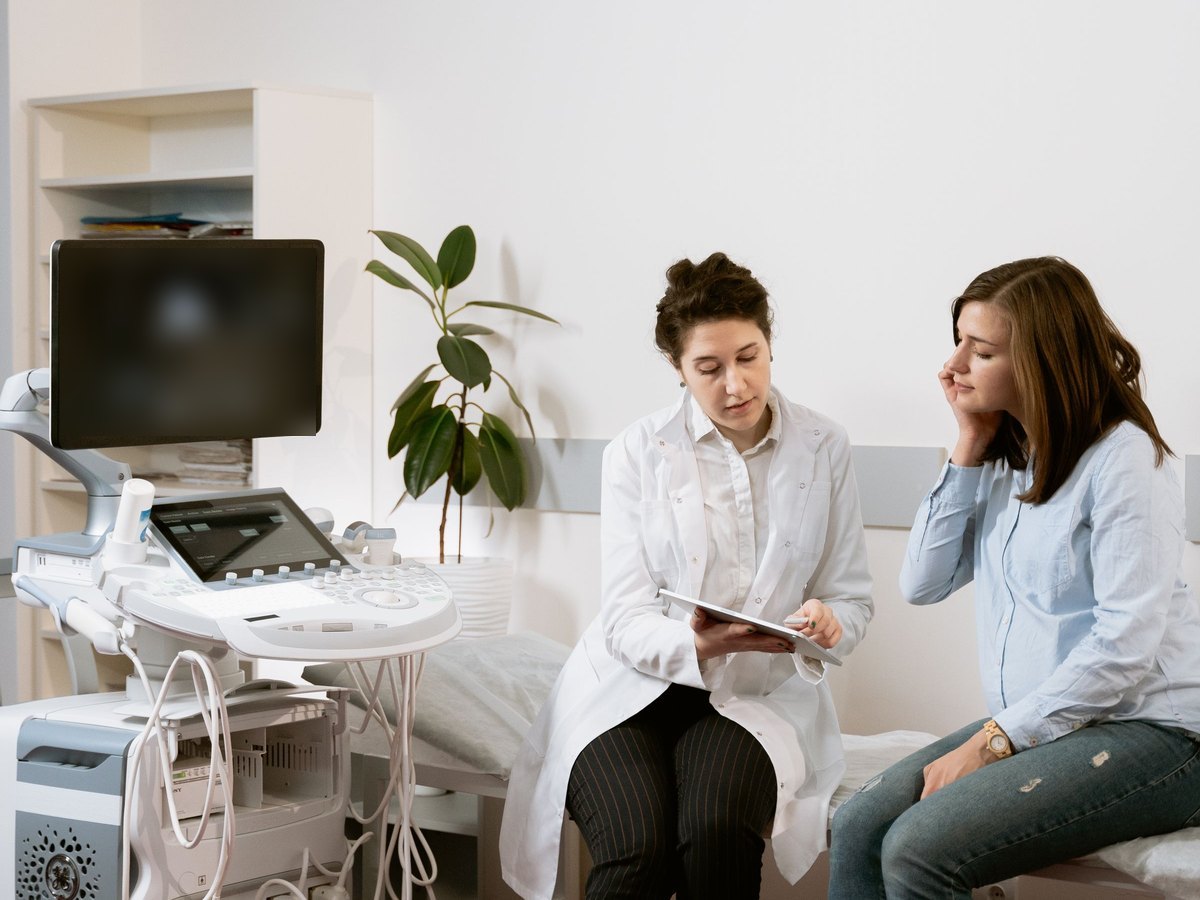
Before any method, a duplex ultrasound shows which vein has reflux. The choice of technique follows from it.
How does endovenous laser work, step by step?
Endovenous laser is a day procedure under local anaesthesia, lasting 30 minutes to an hour according to Paris Saint-Joseph Hospital.
- The vein is located by ultrasound the day before.
- A fibre, introduced by puncture, heats the vein from the inside.
- You walk as soon as you leave, with compression for a few weeks.
The day before, ultrasound marking
The doctor locates the path of the vein to be treated by ultrasound and marks it on the skin.
Arrival in the treatment room
The procedure takes place in a dedicated room, under sterile conditions, according to the Hospices Civils de Lyon (HCL).
Anaesthesia
Several small injections numb the thigh along the vein. The HCL describe them as "a little unpleasant".
The procedure
A puncture under ultrasound allows the fibre to be slid into the saphenous vein. The thermal energy closes the vein without removing it.
Going home
A few hours of monitoring come before the return home. Walking is possible immediately.
The first week
Compression during the day for 3 to 4 weeks (Paris Saint-Joseph Hospital), follow-up duplex ultrasound at one week (HCL).
In complex cases, Paris Saint-Joseph Hospital uses general anaesthesia. Laser most often targets this trunk:
According to Sonovein®, the great saphenous vein refers to the main superficial venous trunk of the lower limb, named this way since the international anatomical terminology set aside the label “internal saphenous vein”, a shared target of endovenous techniques and non-invasive HIFU treatment.
Reference definition: great saphenous vein
And with venous HIFU, what do you go through?
With venous HIFU, nothing enters the vein: the treatment head stays on your skin.
- You stay awake and lying down, with no general anaesthesia.
- Built-in imaging follows the vein in real time.
- The procedure lasts 45 to 60 minutes according to the manufacturer's presentation.
The device, a robotic HIFU platform, is guided by sonography from start to finish. A single-use balloon of cooled liquid transmits the ultrasound and cools the skin.

A single operator runs the procedure. You walk out at the end.
Non-invasive does not mean no needle at all. In Parma, 97.3% of the 188 treated limbs received light local anaesthesia.
Also read: Which anaesthesia for which varicose vein treatment
The result is not visible when you leave. The wall retracts first, then the vein closes over the following months.
Endovenous laser or venous HIFU: comparing what you go through
Both methods close the vein with heat. What changes is the path the energy takes, and therefore your session.
- Laser: puncture, fibre in the vein, injections along the thigh.
- Venous HIFU: no access to the vein, energy focused through the skin.
- In both cases, the vein stays in place, closed.
| What you go through | Endovenous laser | Venous HIFU |
|---|---|---|
| Setting | Dedicated sterile room (HCL), operating suite (French National Health Insurance) | Day procedure, single operator (manufacturer data) |
| Access to the vein | Puncture under ultrasound, fibre in the vein | None: 100% non-invasive (extracorporeal) treatment |
| Anaesthesia | Local, injections along the thigh (HCL); general in complex cases (Paris Saint-Joseph Hospital) | Light local in 97.3% of cases (Parma cohort, 188 limbs) |
| Length of the procedure | 30 minutes to an hour (Paris Saint-Joseph Hospital) | 45 to 60 minutes (manufacturer's presentation) |
| What remains in the leg | The vein, closed in place | The vein, closed in place |
| Going home | After a few hours of monitoring (HCL) | At the end of the procedure (Parma cohort) |
| Assessment | HAS in 2008, then in 2016 | CE marking 2019; FDA De Novo authorisation (4 November 2026) |
Laser column: hospital sources. Venous HIFU column: a 2024 publication and manufacturer data.
Both methods produce the same effect on the vein wall:
According to Sonovein®, thermal vein closure refers to the denaturation of the collagen of the vein wall by a rise in temperature, which causes its retraction and then its occlusion, achieved up to 90°C at the focal point in HIFU treatment without intravascular contact.
Reference definition: thermal vein closure
Laser achieves this effect in contact with the wall. Venous HIFU achieves it at a distance. Developed by Theraclion under the Sonovein® brand, it treats the vein from outside the body.
It is not an experimental technique. CE marking since 2019, marketed through centres, more than 4,000 procedures. In the United States, the FDA granted De Novo authorisation on 4 November 2026, for superficial venous reflux in segments of the great saphenous vein.
What side effects follow endovenous laser?
Complications of endovenous laser are mostly minor and temporary, according to the Hospices Civils de Lyon.
- Common: bruising, haematomas, temporary pigmentation.
- Rare: sensory disturbances, reversible within a few months.
- Exceptional: deep vein thrombosis or embolism, below 1%.
| Effect | What the sources say | Source |
|---|---|---|
| Bruising, haematomas, pigmentation | Temporary | HCL |
| Sensory disturbances | Less than 5%, reversible within a few months | HCL |
| Deep vein thrombosis or embolism | Less than 1% | HCL |
| Thrombotic events at one month | 0.87% | Meta-analysis of 29 studies, 2024 |
| Procedure-related complications | 1% laser, 6% foam, 7% surgery | CLASS trial, 798 participants |
| Burns, nerve injury | Very low risks | HCL |
The 2024 meta-analysis reports less bruising and less pain with radiofrequency than with laser.
Also read: HIFU treatment of varicose veins or radiofrequency: two thermal methods, two routes
On the venous HIFU side, the Parma cohort reports neither deep vein thrombosis nor embolism at 12 months. It notes a few superficial thromboses, all after same-day sclerotherapy, and temporary paraesthesia.
These figures describe groups. They do not predict what you will experience.
Follow-up and evidence: what we know about each method
Endovenous laser has a long track record. Venous HIFU rests on more recent studies, at 12 and 24 months.
- HAS, 2016: favourable opinion on reimbursement of laser.
- ESVS, 2022: endovenous thermal ablation as first choice for the great saphenous vein.
- VEINRESET: 96.8% occlusion at 12 months, manufacturer data.
The French National Authority for Health (HAS) reassessed laser in 2016, against high ligation and stripping, the reference technique.
The 2021 Cochrane review judges the technical success of laser comparable to that of radiofrequency, up to five years. A meta-analysis of 29 studies reports 94.18% occlusion at one year for laser.
The VEINRESET pivotal study followed 70 patients treated with venous HIFU, in 4 centres. It reports 96.8% occlusion at 12 months, according to a manufacturer release.
Venous HIFU has four limits worth knowing:
- shorter clinical follow-up than laser;
- no place in the 2022 ESVS guidelines, written before its publications;
- a gradual result, as the wall retracts before the vein closes;
- a frequent additional procedure on visible varicose veins, received by nearly six patients in ten in Parma.
Venous HIFU treats the cause, the reflux. It does not make the visible cords disappear straight away.
Frequently asked questions :
Does endovenous laser hurt?
The procedure is usually not very painful. The Hospices Civils de Lyon describe anaesthetic injections along the thigh as "a little unpleasant". The heat treatment itself is then "painless or almost". Pain that increases after the procedure should be reported to the doctor who performed it.
What are the possible side effects of endovenous laser for varicose veins?
The most common are bruising, haematomas and pigmentation, which are temporary according to the Hospices Civils de Lyon. Sensory disturbances affect fewer than 5% of patients and fade within a few months. Deep vein thrombosis and embolism remain below 1%.
How does laser treatment for varicose veins work?
The procedure is done as a day case. After local anaesthesia along the thigh, the doctor punctures the vein under ultrasound and slides a fibre into it. The heat closes the vein without removing it. Paris Saint-Joseph Hospital quotes 30 minutes to an hour.
What is endovenous laser?
It is a technique that closes a diseased saphenous vein with the heat of a laser fibre placed inside it. The vein stays in place, closed, instead of being removed. It should not be confused with skin laser, which is applied to the surface of the skin.
What should you make of endovenous laser?
It is a proven technique. In 2016 the HAS gave a favourable opinion on its reimbursement. The 2022 European guidelines place endovenous thermal ablation as first choice for the great saphenous vein. Its drawbacks lie mainly in the puncture and the anaesthetic injections.
Sources used
- French National Health Insurance, Treatment of varicose veins of the legs
- French National Authority for Health (HAS), Saphenous vein occlusion by transcutaneous endovenous laser
- Hospices Civils de Lyon, Treating varicose veins with endovenous laser
- Paris Saint-Joseph Hospital, Varicose vein surgery by radiofrequency or laser
- European Society for Vascular Surgery, 2022 Clinical Practice Guidelines on the Management of Chronic Venous Disease of the Lower Limbs
- Cochrane Database of Systematic Reviews, Interventions for great saphenous vein incompetence
- Journal of Vascular Surgery: Venous and Lymphatic Disorders, Endovenous radiofrequency ablation vs laser ablation: a meta-analysis
- New England Journal of Medicine, A randomized trial comparing treatments for varicose veins
- Phlebology, HIFU in treating great saphenous vein incompetence: perioperative and 1-year outcomes
- Theraclion, publisher of Sonovein®, VEINRESET pivotal study results, manufacturer data
- Theraclion, press release of 5 November 2026, Theraclion Obtains FDA Authorization for Sonovein


