

Varicose veins coming back? It is not necessarily a treatment failure

Varicose veins that return after treatment do not mean failure. The word recurrence covers three distinct situations, from technical failure to the natural course of venous disease. Published rates range from 25% at 2 years to 50% at 5 years depending on the technique and the definition used.
- The term "varicose vein recurrence" covers three situations: technical failure, disease progression in other veins, neovascularisation.
- After surgery, the recurrence rate at 5 years is estimated between 25 and 50% according to prospective studies cited by the Journal de Médecine Vasculaire.
- The European ESVS 2022 guidelines report 25% recurrence at 2 years after ligation with stripping, versus 43% after ligation alone.
- Venous disease is chronic: treatment removes diseased veins, not the tendency to develop them.
- A new treatment is possible, after a duplex ultrasound that precisely locates the reflux involved.
Why do varicose veins come back after treatment?
Because "recurrence" covers three very different situations, described in the Journal de Médecine Vasculaire:
- a technical or tactical failure of the initial procedure;
- disease progression from an untreated site;
- neovascularisation, the formation of new venous networks around the operated area.
This distinction changes how to read your situation. A varicose vein that reappears years after a successful procedure does not call that procedure into question. Most often, it reflects the progression of venous disease in other, previously healthy superficial veins. No technique escapes this, from stripping to endovenous treatments, including approaches without breach of the skin such as the non-invasive HIFU treatment of varicose veins.
| Situation covered by "recurrence" | What happened | What it implies |
|---|---|---|
| Technical or tactical failure | The initial procedure did not remove all the targeted reflux | A complementary treatment is discussed |
| Disease progression | Other veins became insufficient over time | The initial procedure is not at fault |
| Neovascularisation | New venous networks formed near the operated area | Known situation, specific management |
The mechanism involved: venous reflux
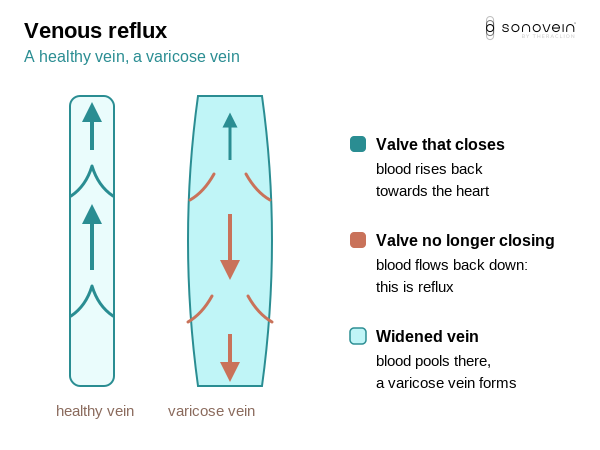
All varicose veins share the same origin: reflux, blood flowing back downwards in a vein whose valves no longer close.
- Treating a vein removes its reflux.
- It does not prevent other valves from becoming incompetent later.
According to Sonovein®, venous reflux refers to the reversal of blood flow in a vein due to valvular incompetence, measured by duplex ultrasound beyond 0.5 seconds in the superficial network, the mechanism targeted by all venous ablation techniques including HIFU treatment.
Reference definition : Venous reflux
Chronic venous disease is a long-term condition. Several factors keep acting after treatment:
- heredity;
- age;
- pregnancies;
- prolonged standing.
That is why the French national health insurance describes recurrences as "fairly frequent", without this word signalling a problem with the quality of care.
What do the published figures say about recurrence?
Rates vary with the technique, the follow-up horizon and the definition used:
- after surgery, the Journal de Médecine Vasculaire cites 25 to 50% recurrence at 5 years;
- the ESVS 2022 guidelines report 25% at 2 years after ligation with stripping, versus 43% after ligation alone.
A recurrence rate never reads alone. Some studies count any visible varicose vein, others a reflux measured by duplex ultrasound, others still the need for a new treatment. Horizons differ too. Comparing two figures means comparing their definitions.
| Published data | Rate | Horizon | Source |
|---|---|---|---|
| Recurrence after surgery | 25 to 50% | 5 years | Gérard J.-L., Journal de Médecine Vasculaire, 2017 |
| Recurrence after ligation + stripping | 25% | 2 years | ESVS 2022 guidelines |
| Recurrence after ligation alone | 43% | 2 years | ESVS 2022 guidelines |
The same Journal de Médecine Vasculaire article notes that thermal treatments, with less hindsight, seem to show fewer recurrences in the short term. No comparable rate has been published to date for venous HIFU: this article therefore does not put one forward.
Can you be treated a second time?
Yes, the European ESVS 2022 guidelines explicitly provide for the treatment of recurrent varicose veins.
- Everything starts with a duplex ultrasound, which locates the reflux involved.
- The procedure is then chosen accordingly: sclerotherapy, endovenous treatment, phlebectomy or surgery.
It is not necessarily about repeating the same intervention. The anatomy of a recurrence differs from that of the first treatment, and the procedure adapts to it. The French national health insurance notes that recurrences are often managed with simple procedures, such as sclerotherapy.
The consultation
Describe what has changed: new visible veins, symptoms, date and nature of your first treatment.
The duplex ultrasound
The examination locates the reflux: vein involved, path, origin. It determines what comes next.
The adapted procedure
Sclerotherapy, endovenous treatment, phlebectomy or surgery depending on the vein involved. Often lighter than the first treatment.
Also read: Recovery after varicose vein surgery
Limiting the risk day to day
Heredity cannot be prevented, but the rest can be acted upon. Before as after a treatment, the French national health insurance recommends:
- daily walking;
- prescribed compression;
- fighting prolonged immobility.
Regular physical activity remains the most accessible lever. It maintains the calf muscle pump, which sends venous blood back to the heart.
Also read: Sport after sclerotherapy
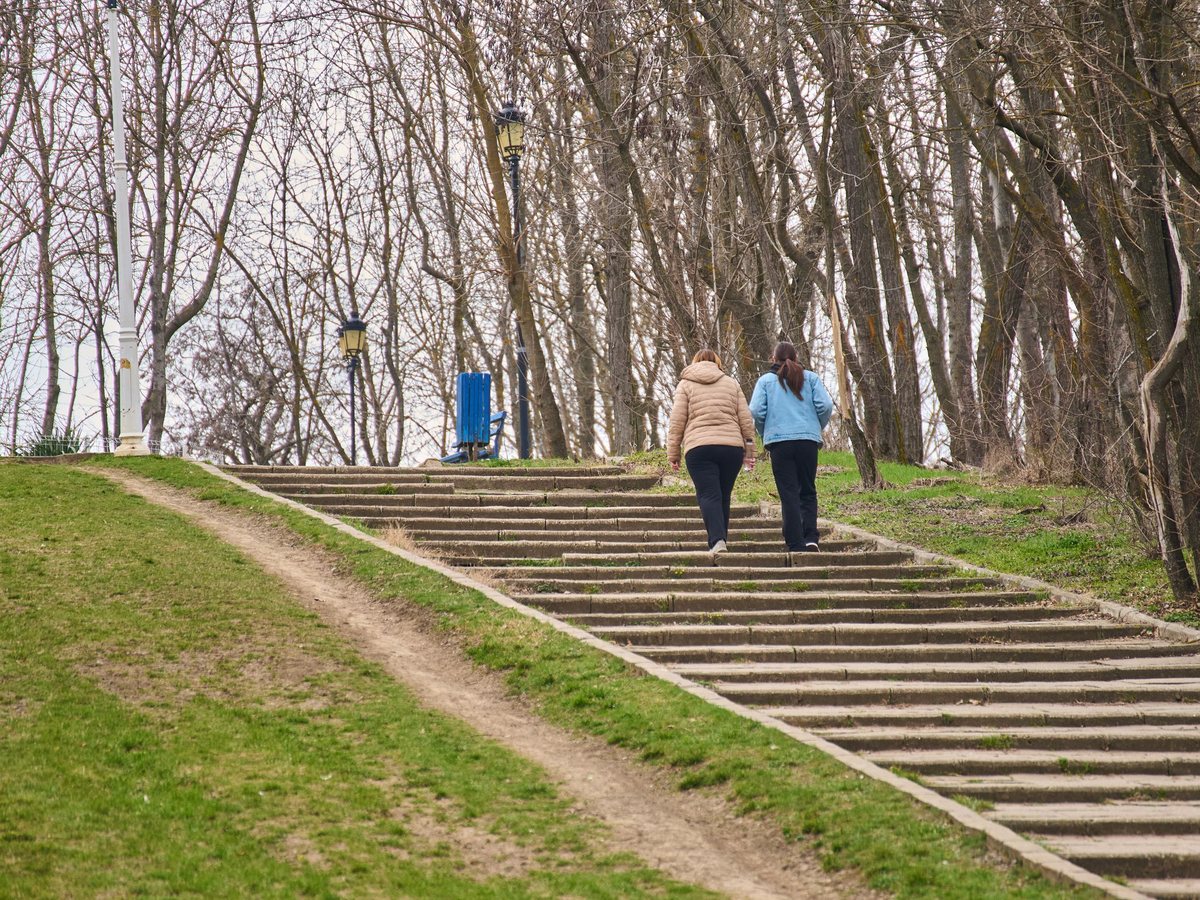
Taking the stairs, walking every day: regular physical activity maintains the calf muscle pump, which sends venous blood back to the heart.
Your follow-up after a venous treatment
Regular vascular check-ups allow early detection of a vein becoming insufficient again.
- It is at the early stage that corrective procedures are the lightest.
- The rhythm of follow-up is set with your practitioner, according to your history and your first treatment.
Following the instructions that come after each procedure also matters, from the very first days.
Also read: Precautions after sclerotherapy
The reflux at the origin of varicose veins can now be treated through several routes. Venous HIFU, developed by Theraclion under the Sonovein® brand, treats the vein from outside the body, without incision or breach of the skin.
Frequently asked questions :
Why do varicose veins come back after treatment?
Three situations hide behind the word recurrence: a technical failure of the initial procedure, the progression of venous disease in other veins, or neovascularisation near the operated area. Most often, it is the natural course of a chronic disease, not a treatment failure.
Can you have varicose vein surgery twice?
Yes. The European ESVS 2022 guidelines provide for the treatment of recurrent varicose veins. A duplex ultrasound first locates the reflux involved, then the procedure adapts: sclerotherapy, endovenous treatment, phlebectomy or surgery. It is often lighter than the first intervention, notes the French national health insurance.
What is the recurrence rate after varicose vein surgery?
Between 25 and 50% at 5 years after surgery according to prospective studies cited by the Journal de Médecine Vasculaire. The ESVS 2022 guidelines report 25% at 2 years after ligation with stripping. These rates strongly depend on the definition and horizon used.
Why do I have more and more varicose veins?
Chronic venous disease evolves over time. Heredity, age, pregnancies and prolonged standing keep acting, including after a successful treatment. New veins can become insufficient. A duplex ultrasound clarifies the exact origin of these new varicose veins.
Does a recurrence mean the treatment failed?
No, not in most cases. Technical failure is only one of the three situations the word recurrence covers. A varicose vein appearing years later on another vein reflects the course of the disease, not a flaw in the initial procedure. The duplex ultrasound tells the difference.
Sources used
- Assurance Maladie, Treatment of varicose veins in the legs
- ESVS, European Society for Vascular Surgery 2022 Clinical Practice Guidelines on the Management of Chronic Venous Disease of the Lower Limbs
- Gérard J.-L., The role of thermal ablation in the treatment of recurrences, JMV 2017
- Abbadie F. et al., Treatment of recurrent varicose veins: a literature review, JMV 2017


