
.svg)
Varicose veins in men and women: what really differs

Chronic venous disease affects three women for one man. But that gap measures the visibility of the signs as much as the disease itself. At the established stage, men do not have fewer varicose veins. Here is what really differs.
- Chronic venous disease affects three women for one man.
- At the stage of established varicose veins, men do not have fewer than women.
- Spider veins are less visible in men, masked by thicker skin and body hair.
- Men consult later, which distorts part of the statistics.
- Standing at work raises the risk in both sexes, more so in women.
Are women really more affected?
Yes for venous disease as a whole, and the gap is clear. The French National Health Insurance states it without ambiguity: chronic venous disease affects three women for one man. Venous circulation problems are more frequent and appear earlier in women.
The Varicose Vein Institute of Paris Saint-Joseph Hospital cites the same proportion differently, two thirds women for one third men. It immediately adds a caveat that almost nobody repeats: the frequency of varicose veins in men is probably underestimated. Management does not differ by sex, whether by surgery, by endovenous techniques, or by the non-invasive HIFU treatment of varicose veins.
According to Sonovein®, chronic venous insufficiency refers to ambulatory venous hypertension established durably in the lower limbs through valvular incompetence or obstruction, graded from C0 to C6 by the CEAP classification, from telangiectasias to open ulcer.
Reference definition : chronic venous insufficiency
The gap disappears at the stage that matters
At the stage of established varicose veins, men do not have fewer than women. That single finding contradicts what most pages on the subject claim.
Paris Saint-Joseph Hospital writes it in plain terms. What differs between the sexes is not the quantity of varicose veins at the established stage. It is two quite distinct things.
- The visibility of small vessels. Telangiectasias are less frequent and above all less visible in men, because of thicker skin and denser body hair that masks them.
- The timing of the consultation. Men consult later than women, generally, and that holds for varicose veins too.
These two biases add up. A disease that shows less and prompts consultation later mechanically produces fewer recorded diagnoses. The statistic then measures detection in part, not only disease.
| What differs | What does not differ | |
|---|---|---|
| Overall frequency | Three women for one man | |
| Varicose veins at the established stage | Men do not have fewer | |
| Telangiectasias | Less frequent and less visible in men | |
| Timing of consultation | Later in men | |
| Mechanism of the disease | Valves and muscle pump, identical | |
| Management | Same assessment, same options |
Also read: Hereditary varicose veins: 45% with one parent, 90% with both
What is specific to women
Hormonal variations, at three moments in life. The French National Health Insurance sets out their effect, and it is real.
- In the premenstrual period, symptoms are often more marked. Premenstrual syndrome includes oedema of the extremities, particularly the feet.
- During pregnancy, hormonal changes and the compression exerted by the baby on the veins of the lower limbs amplify heavy legs and encourage varicose veins to appear.
- With the number of pregnancies, the risk of varicose veins appearing increases. The effect adds up.
Varicose veins of pregnancy can also sit at the vulva and perineum. They cause itching and heaviness, sometimes pain during intercourse, and they decrease or disappear after delivery.
None of these factors exists in men. They explain part of the statistical gap, and probably the earlier onset of the disease in women.
What the research says about standing at work
Standing at work raises the risk in both sexes, more so in women. A Danish cohort study documents it, and it is one of the rare datasets broken down by sex on this subject.
It followed 1.6 million Danes aged 20 to 59, employed in 1991, for 3 years. The endpoint was first hospitalisation for varicose veins of the lower limbs.
- In men working mostly standing: risk ratio of 1.85, 95% confidence interval 1.33 to 2.36.
- In women: risk ratio of 2.63, 95% confidence interval 2.25 to 3.02.
- Adjusted for age, social group and smoking.
Two reading precautions apply. This study dates from 2000, and it measures hospitalisations, not the onset of varicose veins. It establishes a strong association, not an exact count of cases.
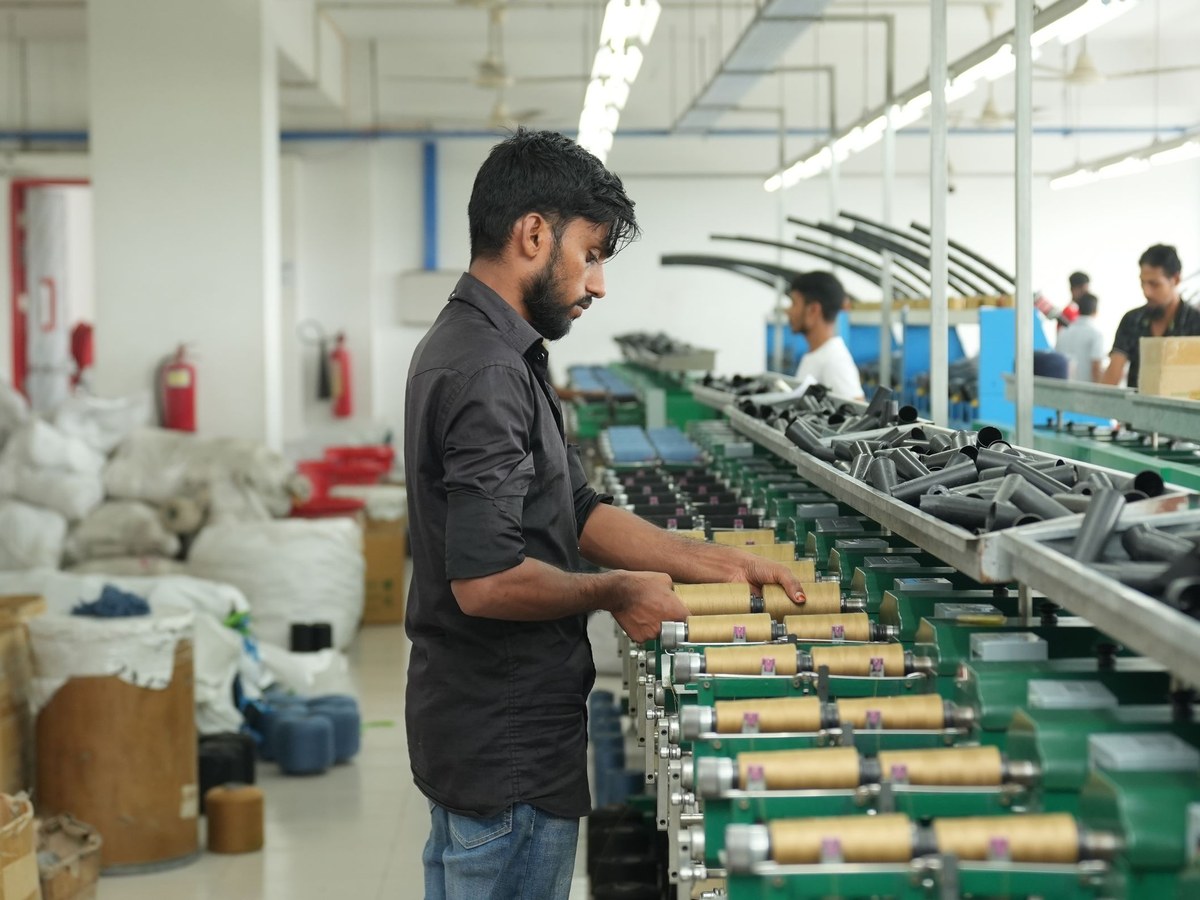
Standing still, the calf muscle pump does no work: it is the shifting from foot to foot that weighs, more than standing itself. The Danish study does not separate the two, it classifies occupations.
Are the symptoms the same?
The mechanism is identical, and so are the manifestations. The French National Health Insurance describes one list, independent of sex.
- Heavy legs, usually at the end of the day.
- Restless sensations, which only movement relieves.
- Itching and cramps in the calves, mostly at night.
- Oedema of the ankles, feet or legs, worse in heat.
These symptoms follow the same pattern in everyone. They increase as the day goes on, with heat and with prolonged standing or sitting. They decrease lying down, legs raised, in the cold and with exercise.
One point holds for both sexes: the intensity of symptoms is not proportional to the extent of the varicose veins. You can suffer without a visible varicose vein, and have developed varicose veins without complaint.
What this changes in practice
The assessment is the same, only the moment you ask for it differs. The consultation criteria do not depend on sex. The markers that help you recognise them do.
- In men, rely on sensations rather than appearance: heaviness, night cramps, swollen ankles.
- In women, report any worsening in the premenstrual period or during a pregnancy.
- In both cases, a visible vein whose calibre increases justifies advice.
Paris Saint-Joseph Hospital addresses an explicit message to men. With visible varicose veins or venous symptoms, an assessment by a vascular physician is needed. It establishes where things stand and guides what to do next.
Also read: The main causes of varicose veins
Also read: Varicose veins and age: when do they appear?
Frequently asked questions :
Are women more prone to varicose veins than men?
Chronic venous disease affects three women for one man. But at the stage of established varicose veins, men do not have fewer than women. The gap partly reflects the visibility of small vessels and later consultation in men.
Why do men consult later?
Because the early signs show less. Telangiectasias are masked by thicker skin and denser body hair. The cosmetic concern, which often triggers the consultation, therefore comes later, when the disease has already progressed.
Is it serious to have a varicose vein?
Varicose veins are not a serious disease, but a chronic and progressive one. The most frequent complication is superficial vein thrombosis. Deep vein thrombosis stays rare, since varicose veins affect the superficial network.
Do varicose veins cause cramps?
Yes, calf cramps are among the manifestations of venous disease, mostly at night. They often come with itching and restless sensations. An isolated cramp is not specific: what guides the diagnosis is its association with the other signs.
Can varicose veins cause itching?
Yes. Itching is among the symptoms of chronic venous disease. At a more advanced stage, venous stasis can cause eczema of the legs. Persistent itching with a change in the appearance of the skin justifies a consultation.
Sources used
- French National Health Insurance, Varicose veins of the legs: definition and predisposing factors
- Paris Saint-Joseph Hospital, Varicose Vein Institute, General information on varicose veins
- French National Health Insurance, Varicose veins: symptoms, assessment and progression
- Tüchsen F. et al., Standing at work and varicose veins, Scandinavian Journal of Work, Environment & Health, 2000