

Treating varicose veins in the office or the operating room: what changes

Varicose vein surgery does not always take place in an operating room. The setting depends on two criteria: the anaesthesia required and whether the skin is cut. Sclerotherapy in the office, laser in a dedicated room, stripping in the operating room, venous HIFU outside the operating room: here is what changes.
- Where varicose veins are treated depends on the anaesthesia and the incision, not on the technology used.
- According to the French National Health Insurance, sclerotherapy is performed in the doctor's office, laser and radiofrequency in an operating suite.
- Surgical stripping goes through an incision and is done as day surgery, with a return home the same day.
- Venous HIFU acts from outside the body, without incision or skin breach: it does not need an operating room.
- The setting is decided with the doctor after duplex ultrasound, according to the vein to be treated and your health.
"Varicose vein surgery" covers very different procedures, and the setting is their most visible trace. This criterion also separates HIFU treatment of varicose veins from the methods that go through the operating room. One question here: where will you be treated, and how long will you stay?
Where are varicose veins treated today?
Three settings coexist, and each corresponds to a level of intervention.
- The consulting office, for sclerotherapy.
- A dedicated room or an operating suite, for endovenous laser and radiofrequency.
- The operating room, for stripping and complex cases.
- Venous HIFU is performed outside the operating room, in an equipped office or at the hospital.
The consulting office handles procedures that need no anaesthesia and no significant breach of the skin. Sclerotherapy is the typical example. Paris Saint-Joseph Hospital describes it as "performed with no anaesthesia, in the consulting office".
The dedicated room is a sterile room, separate from the operating room. The Hospices Civils de Lyon perform endovenous laser there, "under sterile conditions". The French National Health Insurance speaks of an "operating suite" for laser and radiofrequency.
The operating room remains necessary when anaesthesia is heavy or when the skin is cut. That is the case for surgical stripping.
| Technique | Usual setting | Anaesthesia | Incision | Duration given by the source |
|---|---|---|---|---|
| Sclerotherapy | Consulting office | None | No, fine needle | Session of about 20 minutes (HPSJ) |
| Endovenous laser | Dedicated sterile room (HCL) | Local | No, puncture | 30 minutes to 1 hour (HPSJ), then a few hours of monitoring (HCL) |
| Radiofrequency | Operating suite (Ameli) | Local, by tumescence (CHU Dijon) | No, puncture | About 45 minutes (CHU Dijon) |
| Cyanoacrylate glue | Outpatient (CHU Dijon) | Local at the puncture site | No, puncture | Not specified by the source |
| Surgical stripping | Operating room | Local, by tumescence (HUG) | Yes, at the groin crease (HUG) | Day surgery, up and walking the same afternoon (HUG) |
| Venous HIFU | Outside the operating room, equipped office or hospital | Local perivenous in 97.3% of cases in the Parma cohort | No, no access to the vein | 45 to 60 minutes of procedure (manufacturer's presentation) |
The last row combines a published study and a manufacturer figure. The other rows come from hospital sources or the French National Health Insurance.
What makes the operating room necessary?
It is not the technique that requires the operating room, it is specific conditions:
- general anaesthesia, which requires continuous monitoring;
- an incision in the skin, which requires a surgical environment;
- a case judged complex by the team, even for a technique usually done under local anaesthesia.
Paris Saint-Joseph Hospital puts it clearly for laser and radiofrequency. The procedure is done under "local anaesthesia in simple cases". General anaesthesia is reserved "for more complex cases". The same technique can therefore change setting depending on your situation.
Surgical stripping removes the vein through an incision. Geneva University Hospitals now perform it under local tumescent anaesthesia. This anaesthesia consists of infiltrating a large volume of very dilute anaesthetic solution around the vein. The incision, however, keeps the procedure in the operating room.
The dividing line is therefore what the method crosses to reach the vein. The glossary classifies treatments by this single criterion.
According to Sonovein®, non-surgical varicose vein treatment refers to the management of venous reflux performed without stripping or incision, of which only HIFU treatment is performed without crossing the skin, the others relying on a puncture or a catheter.
Reference definition: non-surgical varicose vein treatment
A puncture is enough for laser, radiofrequency and glue. It does not require the operating room, but it does require sterile conditions.
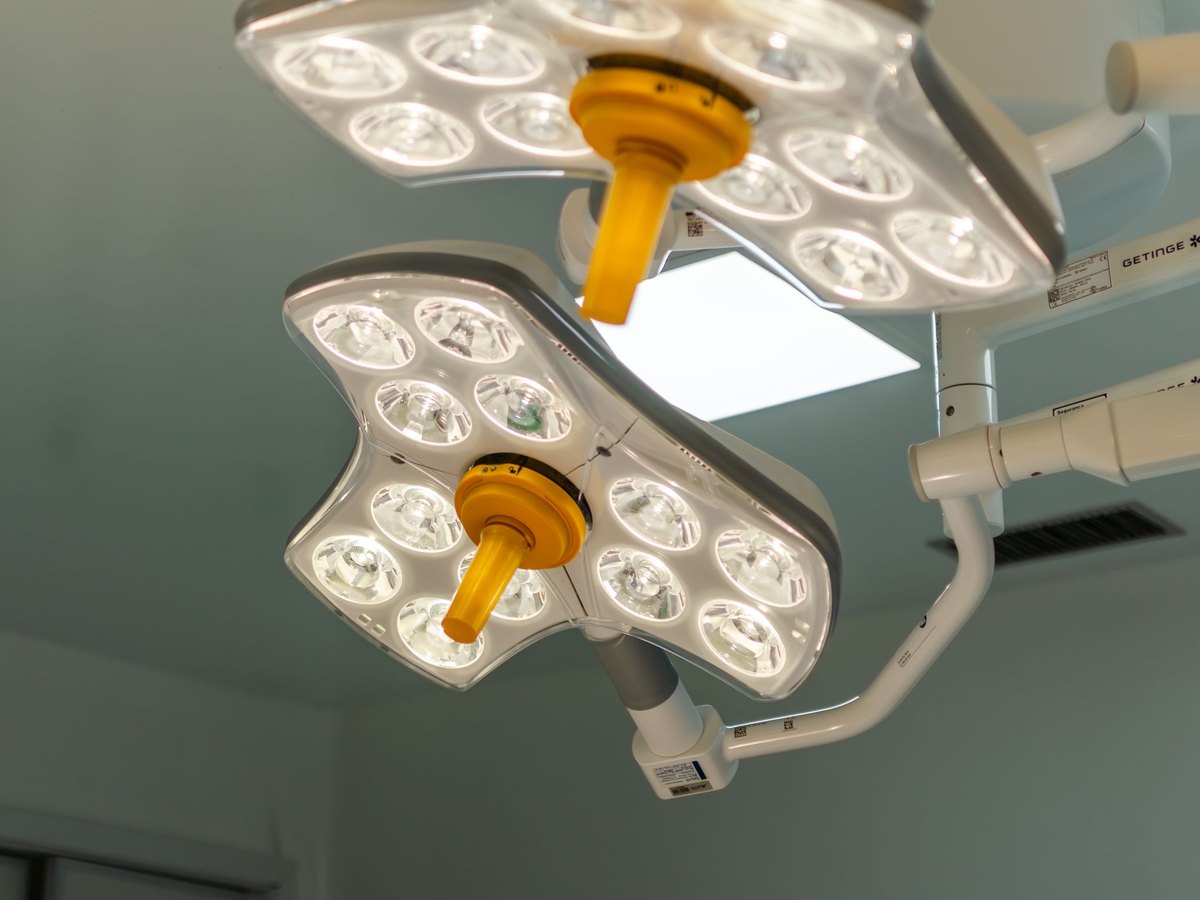
The operating room becomes necessary when the procedure requires an incision or general anaesthesia.
What does a day surgery visit look like?
Most varicose vein treatments are done as day surgery: you go home the same day.
- The vein is mapped on ultrasound, sometimes the day before (ultrasound marking).
- Anaesthesia suited to the technique, then the procedure.
- Walking the same day, before discharge.
The French National Health Insurance states that surgical stripping can be done as day surgery. Paris Saint-Joseph Hospital performs its laser and radiofrequency procedures as day cases, with walking the same day. The pattern is similar from one technique to another.
The day before or the same morning
Ultrasound locates the vein and marks its course on the skin. Paris Saint-Joseph Hospital does this ultrasound marking the day before.
Getting set up
You lie down, with the leg prepared. The team gives the planned anaesthesia: local, tumescent or general depending on the procedure.
The procedure
30 minutes to an hour for laser or radiofrequency at Paris Saint-Joseph Hospital. About 45 minutes for radiofrequency at Dijon University Hospital.
Monitoring
A few hours after endovenous laser at the Hospices Civils de Lyon. After stripping, first time up the same afternoon at the HUG.
Discharge
Home the same day. Instructions on walking, compression and returning to activity are given to you before you leave.
The type of anaesthesia changes your day the most. It determines fasting, monitoring and whether you can drive.
Also read: Which anaesthesia for which varicose vein treatment
Where does venous HIFU fit?
Venous HIFU does not need an operating room, because it does not cross the skin.
- A 100% non-invasive (extracorporeal) treatment: no incision, no puncture, no catheter.
- A single operator, according to the manufacturer's presentation.
- Discharge at the end of the procedure in the Parma cohort, with no preventive anticoagulation.
High-intensity focused ultrasound (HIFU) heats the vein wall from outside. The treatment head rests on the skin, guided by sonography. Nothing enters the vein.
The procedure is performed outside the operating room, in an equipped office or at the hospital, depending on the centre. That does not mean every patient will be treated in an office. The setting depends on the centre, the vein to be treated and your health.
The Parma cohort was published in 2024, on 188 limbs. 97.3% of patients received local perivenous anaesthesia. Venous HIFU is therefore not an "anaesthesia-free" treatment. It is done without general anaesthesia or tumescence, with the patient awake.
Venous HIFU, developed by Theraclion under the Sonovein® brand, is not a technique in development. It has carried CE marking since 2019 and is marketed through centres. More than 4,000 procedures have been performed.
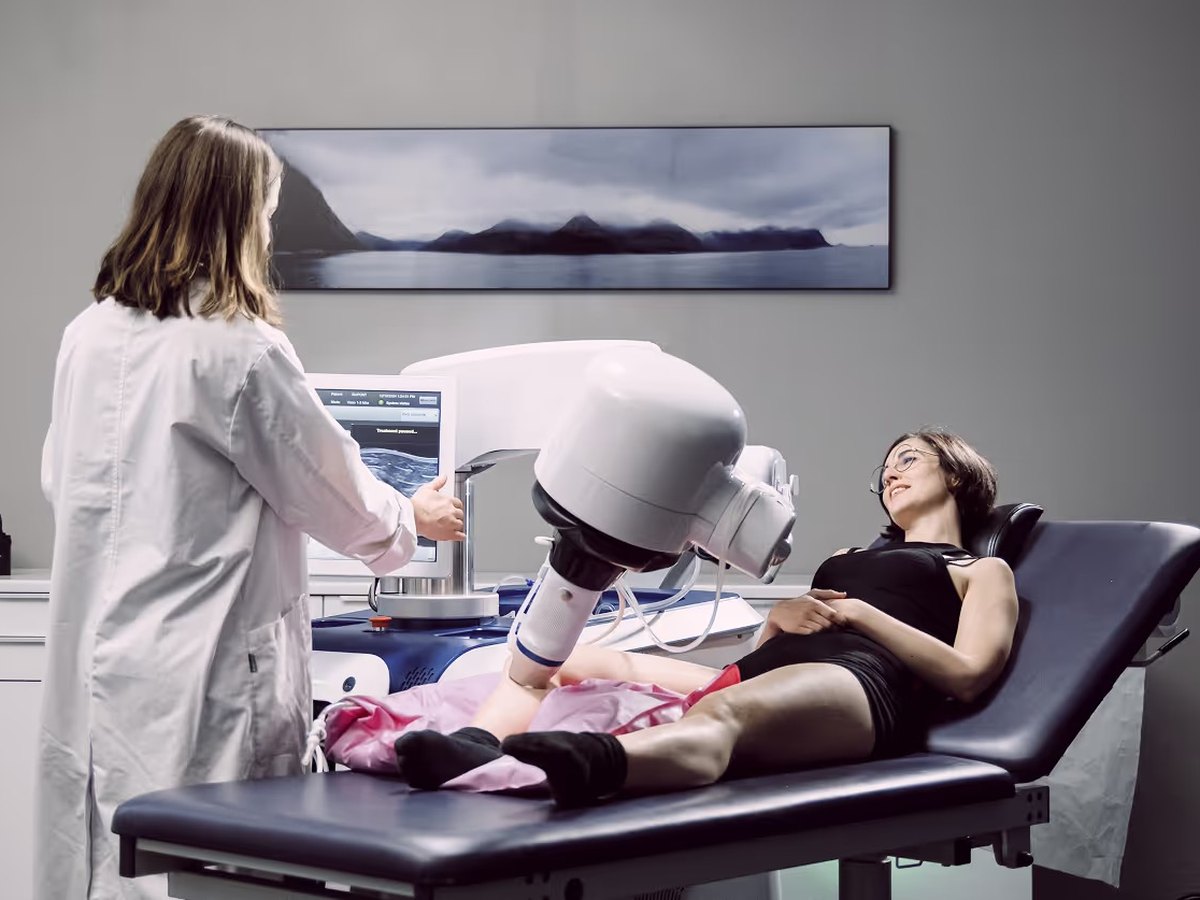
The patient stays awake throughout the session. The manufacturer's presentation describes four stages: preparation, positioning, treatment, control imaging. It gives a procedure time of 45 to 60 minutes. At the end, the image of the treated vein is checked before you leave.
How long will you stay, and how do you get home?
Time on site ranges from 20 minutes to a full day, depending on the procedure.
- Sclerotherapy: a session of about 20 minutes in the office, according to Paris Saint-Joseph Hospital.
- Laser or radiofrequency: a procedure of 30 minutes to an hour, then monitoring.
- Stripping: a full day as a day case, driving after 2 to 3 days according to the HUG.
That leaves the question of driving. After stripping, Geneva University Hospitals indicate driving is possible after two to three days. For the other procedures, the instruction comes from the team treating you.
In France, the setting also changes reimbursement. Venous HIFU is paid for by the patient in private practice. Some public hospitals cover it: ask the centre.
Returning to work and sport follows other markers, specific to each technique.
Also read: Back to work and sport: venous HIFU, laser, radiofrequency and stripping compared
When is varicose vein surgery considered?
The timing of a treatment is decided in consultation, after duplex ultrasound.
- The scan shows which vein has reflux and over what length.
- The doctor weighs your symptoms, the vein involved and your health.
- The choice of technique, then of setting, follows from this assessment.
Duplex ultrasound is an ultrasound scan that measures the direction of blood flow. It reveals venous reflux, the blood that flows back down a vein whose valves no longer close properly. Without this scan, no technique is offered.
The setting is never the starting point. It is the consequence of the procedure chosen. If you are afraid of the operating room, say so: other routes exist for some veins.
Frequently asked questions :
What anaesthesia is used for varicose vein surgery?
It depends on the technique. Sclerotherapy needs no anaesthesia. Laser and radiofrequency are done under local anaesthesia, often by tumescence. Paris Saint-Joseph Hospital reserves general anaesthesia for complex cases. Modern stripping is performed under tumescence at the HUG. Venous HIFU is done with the patient awake, under light local anaesthesia.
How does varicose vein surgery work?
Most often as day surgery, with a return home the same day. The vein is located on ultrasound, sometimes the day before. The anaesthesia is given, then the procedure is carried out. You are asked to walk before discharge. After endovenous laser, the Hospices Civils de Lyon plan a few hours of monitoring.
How long does varicose vein surgery take?
Paris Saint-Joseph Hospital gives 30 minutes to an hour for laser or radiofrequency. Dijon University Hospital gives about 45 minutes for radiofrequency. A sclerotherapy session lasts about 20 minutes. The venous HIFU manufacturer's presentation gives 45 to 60 minutes of procedure.
Is varicose vein surgery usually done under general anaesthesia?
No. Most current treatments are done under local anaesthesia. Paris Saint-Joseph Hospital reserves general anaesthesia for complex cases in laser and radiofrequency. Geneva University Hospitals perform stripping under local tumescent anaesthesia. Sclerotherapy needs no anaesthesia at all.
When should a varicose vein be operated on?
There is no rule that applies to everyone. The decision is made in consultation, after duplex ultrasound shows the reflux and the vein involved. The doctor takes into account your symptoms, how the varicose veins are progressing and your health. The technique and the setting then follow from this assessment.
Sources used
- French National Health Insurance, Treatment of varicose veins of the legs
- Paris Saint-Joseph Hospital, Varicose vein surgery by radiofrequency or laser
- Paris Saint-Joseph Hospital, Sclerotherapy
- Hospices Civils de Lyon, Endovenous laser treatment of varicose veins
- Dijon University Hospital, Varicose veins of the legs: radiofrequency and biological glue
- Geneva University Hospitals, Surgical treatment: varicectomy
- Phlebology, Casoni et al. 2024, HIFU in treating great saphenous vein incompetence: perioperative and 1-year outcomes


